
Cube Artist Spotlight: Jeff Perrott
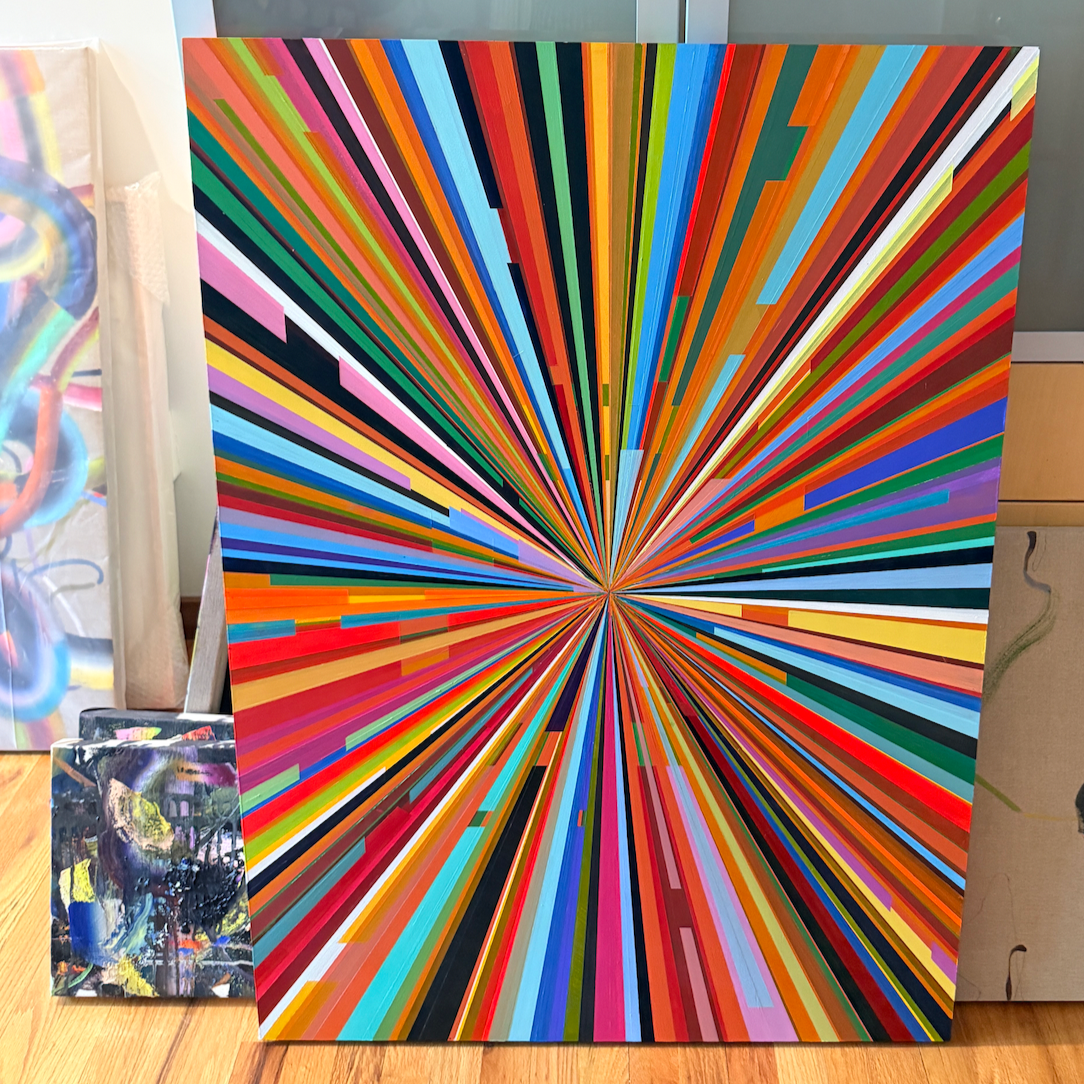
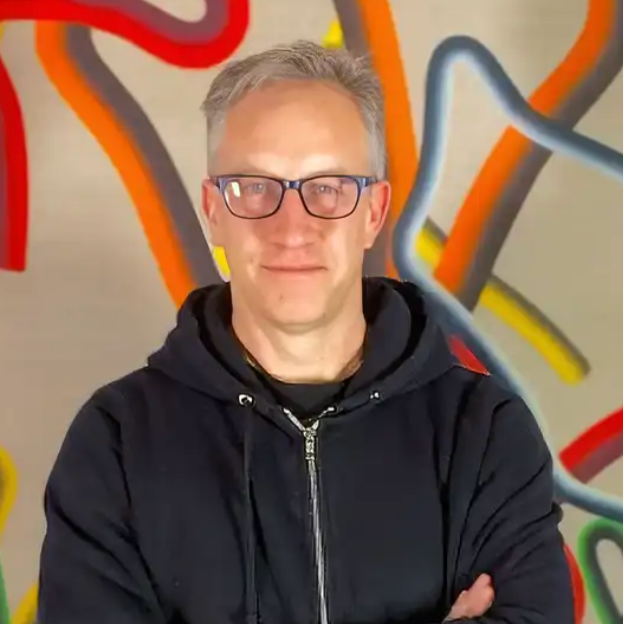
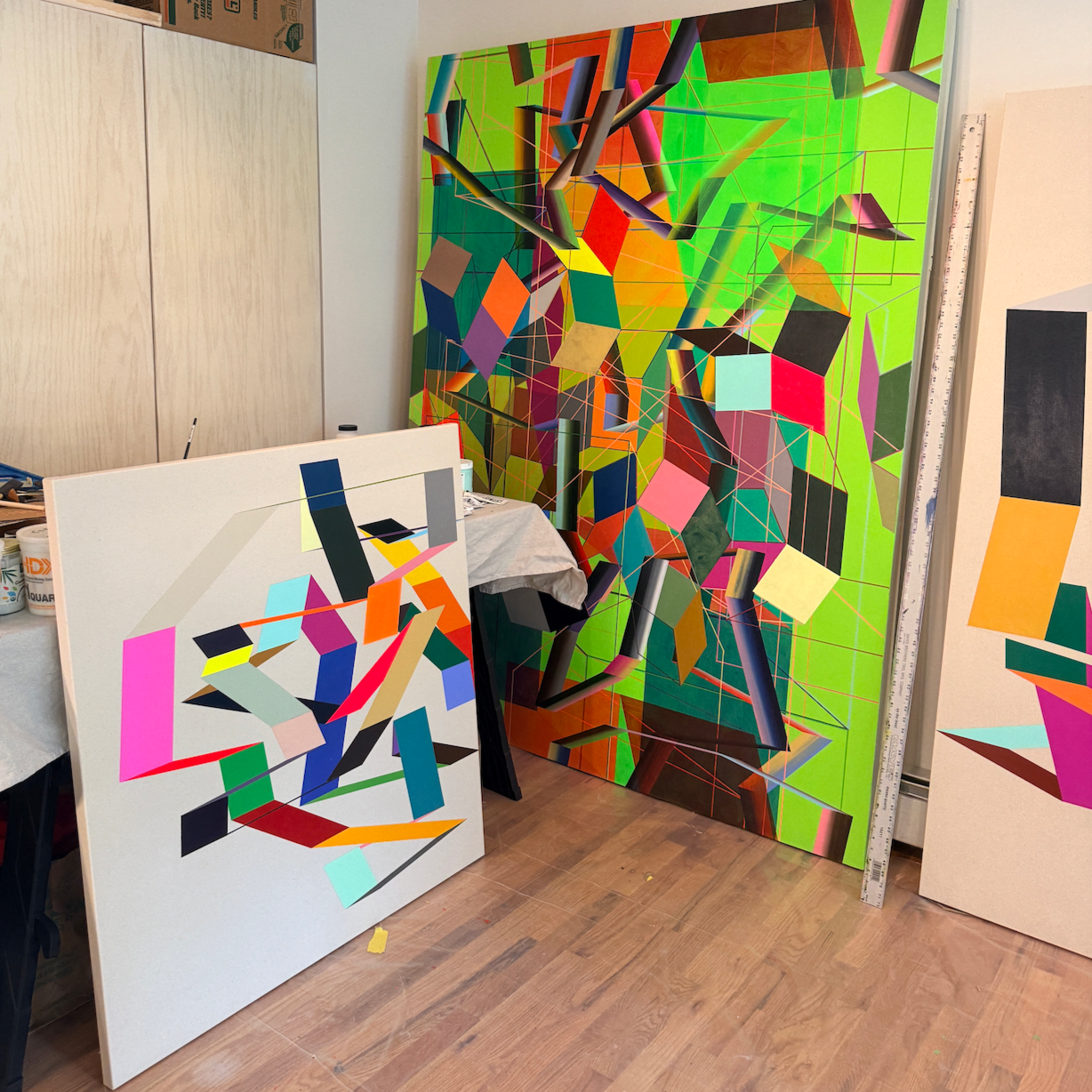
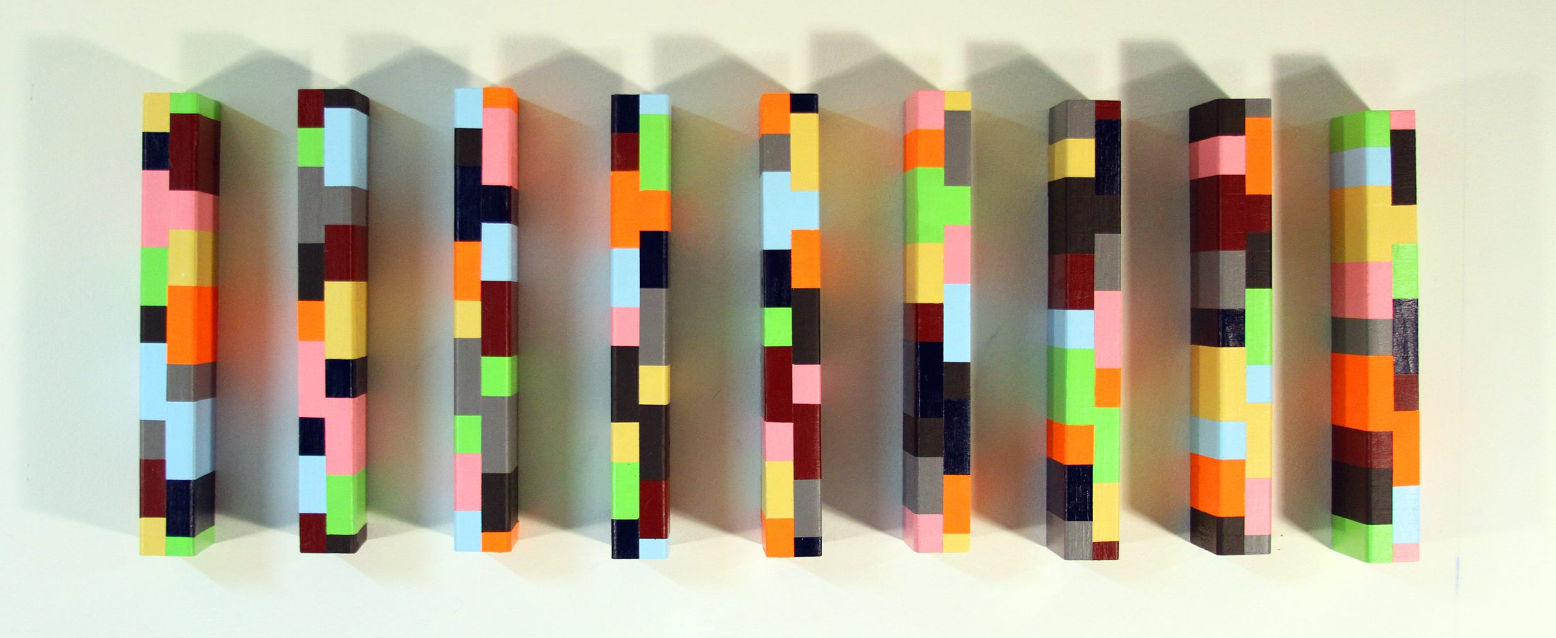
Visiting Jeff Perrott’s bungalow studio is pure pleasure. The space is a kaleidoscope of the most incredible yet unexpected colors, squiggles, drips, and parallel lines folding and unfolding across canvases, sculptures, and wall installations. Jeff is an artist whose abstract paintings prioritize color, systems, intuition, chance — and most rewarding, us, the viewer. Jeff’s works are also pretty heady; he could have been a mathematician instead of a magician with paint, yet the work is physical; they keep us looking. Part meditative, part surprising, it is hard to deconstruct these constructions, even when all the information is readily available. There are no tricks, just a playful mind and incredible skill as a painter. His latest series, ‘Containers’—a subset of his ‘Construction’ project—is one of my favorites yet. In this series, Jeff’s colors build into shapes that push and pull, fold and unfold across the canvas, never seeming to arrive at a final destination. Like a problem set to solve together, these works are full of tension and possibility, order and chaos; perhaps the perfect reflection of the world we find ourselves in today. Constraints abound, but so do possibilities of imaginative spaces that are fresh and energizing.
Below are some snippets from my conversation with Jeff Perrott.
I continue to feel this amazing sense of being put together again when I'm putting paint on a surface
LSL: So I thought you could pick your favorite painting you are working on right now and explain what you see as both a painter and a viewer.
JP: My favorite recently completed painting is a 42 x 39 piece with the nickname 'lurker' - it's a tongue-in-cheek way of referring to the way the form meanders on the outside edges of the painting and how - at least for me - the color is more restrained, withdrawn. Usually, really bright, saturated colors take center stage in this series, but here they accent the browns, grays, and muted tones that dominate. I also like the empty space in the middle - that all the action happens at the edges. So it does several unexpected things that forced me to stretch my use of color and form inventively.
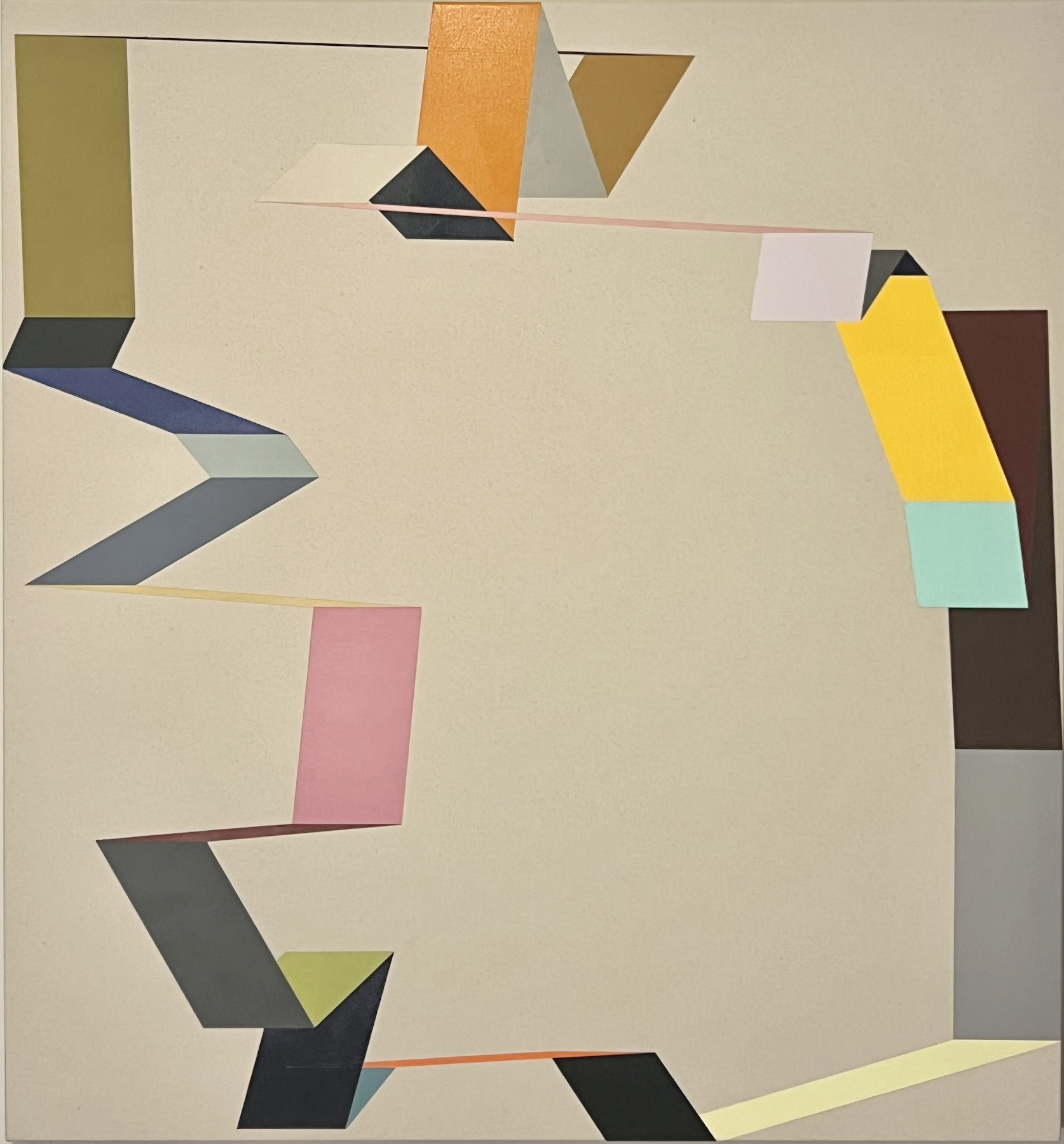
LSL: I like how ‘lurker’ is a little bit of a wallflower - we can use a few more of those in today’s world. I am curious if you can expand on how you stretched your use of color and form? You mentioned you are starting to give the work titles, like ‘lurker.’ Has that allowed you to signal what the works are about?
JP: Yes, I think so. Originally I sought to genericize the titles to keep them as open as possible. But as I made them, I started to see them as figurative, as acting within the picture plane and against the edges in very distinct ways that gave each one a unique ‘personality.’ ‘Container (Lurker)’ is a great example of that—that name came out of the painting process, what happened on the canvas I didn’t start with the name and then use the form to caption it. They all happen like that—the title emerges after it’s finished. Every painting evolves a unique color ‘problem’ because I’m looking to challenge my own assumptions and habits of color, to push myself to constantly invent new color situations—those close-value grays and muted tones in Lurker were a ‘stretch’ in that in one sense they are very close and in another—if you look—they are very divergent. Also, the punctuation of just a few saturated colors gave the sense of muted excitement I think this figure exemplifies.
There’s color—my first and lasting love in painting
LSL: What are you thinking about more generally in the ‘container’ series?
JP: In this 'container' series the challenge is in working within the constraint of the edges, as opposed to past work, which extended form across the edges. The strict opaque, hard-edged geometry is another constraint. Within those constraints, I'm trying to build several tensions into the work, that I hope will make the eye move in a varied, dynamic, and always changing way - I hope looking again will always bring something new. The first tension is in the way the geometry shifts from flat to three-dimensional depending on how you look; the second tension is in how the form relates to the edges and empty space; and the third is of course how I'm using color - using surprising juxtapositions that expand instead of reduce the palette. These tensions, I think, push and pull the eye in surprising ways in what looks initially like a very simple form.
Nothing is explicitly stated so the work asks me to write the story
LSL: Why abstraction?
Abstraction for me is a space of both formal and thought-based play and invention. Viewing abstraction always conducts me into a space of thought - . Abstract visual form is both explicit (it can’t be anything else) and, at the same time, nothing is explicitly stated. I love that tension—the work asks me to write the story, in a sense, but within the constraints of what’s given. I love the freedom there. But in my work I try to balance that freedom with a grounding formal rigor that guides the story. When my Yale mentor Mel Bochner challenged me to employ a system to disrupt my habitual ways of making art, he introduced to me something that could be grounding. There's a necessity and contingency to using a system I really like. I guess that's a 'scaffolding' moment in that it became a permanent feature of my work and I have used it in many different modes as a way to play in the tension between something given (the rules of the system) and something desired (what my will and intuition say). I think of this as kind of a fundamental tension in being human - what is given and what we want.
These tensions, I think, push and pull the eye in surprising ways
LSL: Tension is how your spaces activate?
JP: ‘'Tension' I think is not just a feature of being human, but is also a key feature of what I think of as good art. It can be formal and conceptual, as in my work, or it can be political, or attack norms and conventions, etc. But I think every piece of art that causes you to look a second and third time has some kind of tension at its core. Otherwise, it wouldn't appear as anything special, it would be another piece of furniture. Being conscious of this, its relation to my description on being human, and how it creates a field of play and thought, is I think, the main modus operandi in how I construct a painting.
LSL: There’s something underlying all your works, even though they don’t look alike. Are you interested in people knowing that is a Jeff Perrott painting?
JP: Ha! Not really—maybe to my own detriment! But people often say they recognize my work across the very different things I make and I like thinking that they are recognizing the thought in the work, what goes beyond form. I often use the word ‘contingency’ to describe what connects all these things for me, and something Nancy Stapen wrote about my work in 1997—that it is about order and chaos. I’ve never been interested in a signature style or way of working, and I often challenge myself to try things I previously said I will never do! Pouring paint is one of those, for example—but I liked the contingency of the organic shapes that emerged, and the play between my willful control of those flows, and what they want to do that’s out of my control—there’s a tension that gets realized on the surface of those paintings.
Of course, then, there’s color—my first and lasting love in painting. People say it’s very passe or kitsch to be involved in color as deeply as I am, but it’s a true fetish—I love it—and I think there’s a lot of territory to be mined there. I think your eye will recognize my attitude toward and use of color over time.
I like thinking that they are recognizing the thought in the work, what goes beyond form
LSL: A question I am always curious about, why do you paint?
Speaking of fetishes—this may sound odd but there's something completely pleasurable about the act of painting for me that's been there since my mom taught me how when I was really young. Even in high school when I wasn't taking formal art classes, I would go into the art room with friends after school and just make for making's sake, just kind of geek out. In college and at Yale that was overlaid with ideas and concepts and philosophy and politics and everything art is, and, as you know, thought and philosophy and ideas are super important to me - but I continue to feel this amazing sense of being put together again when I'm putting paint on a surface, looking at and mixing color, using the material in different ways... I've poured it, thrown it, done really fine representational work - I just love using paint, period. They say painting isn't therapy for artists and I agree with that, it's not therapy for me but a kind of deep identity and wholeness I get reconnected with when I do it. If there is such a thing as essence I think this would be it for me.
____________________________________
Jeff Perrott is an abstract painter working in Cambridge, MA. He did his undergraduate work at Williams College and his MFA at Yale School of Art (1992). He has been the subject of merely 20 solo exhibitions in Boston at Barbara Krakow Gallery in Boston and Morgan Lehman Gallery in New York, and more recently at LaMontagne Gallery in Boston. His work is in the permanent collections of the Museum of Fine Arts, Boston, Wadsworth Atheneum, Yale University Art Gallery, DeCordova Sculpture Park and Museum, The Whitney Museum of Art, Tufts University Art Galleries, among others. He is the recipient of the Eben Demerest Fellowship and was nominated for the ICA Foster Prize. Jeff is represented by LaMontagne Gallery in Boston.
Lisa Lebovitz is the co-founder of Cube Art Boston along with Beth Schlager. Their mission is to raise the visibility of local artists working in and around Boston through various means, including small group studio visits and art matchmaking. For more information on Jeff or Cube, reach out at cubeartboston@gmail.com.